Zero Hidden Defects: VSNDT P-Series Industrial Endoscope - Specialized NDT Solution for Aerospace
The aerospace industry adheres to the most stringent nondestructive testing (NDT) standards, following NAS410 aviation inspection specifications with core requirements of zero disassembly, zero secondary damage, and micron-level defect detection. Aircraft and rocket engines extensively use closed cavities, micro-flow channels, and long curved pipelines, where over 90% of internal inspection areas are not visible to the naked eye. Forced disassembly not only costs hundreds of thousands of dollars but also damages original sealed structures and introduces foreign object debris (FOD).
VSNDT P-Series industrial endoscopes, with a full range of probes from 0.75mm to 6mm and customizable pipeline lengths from 0.5m to 30m, paired with aviation-grade anti-interference imaging and flexible pipeline structures, cover the entire lifecycle of component production, assembly, in-service maintenance, and overhaul inspection. This specialized solution addresses four extreme aerospace inspection challenges: ultra-fine aperture access, long-distance curved navigation, high-temperature residue resistance, and high-cleanliness environment compliance, making it the mainstream domestic borescope for civil aviation MRO and aerospace component manufacturing.
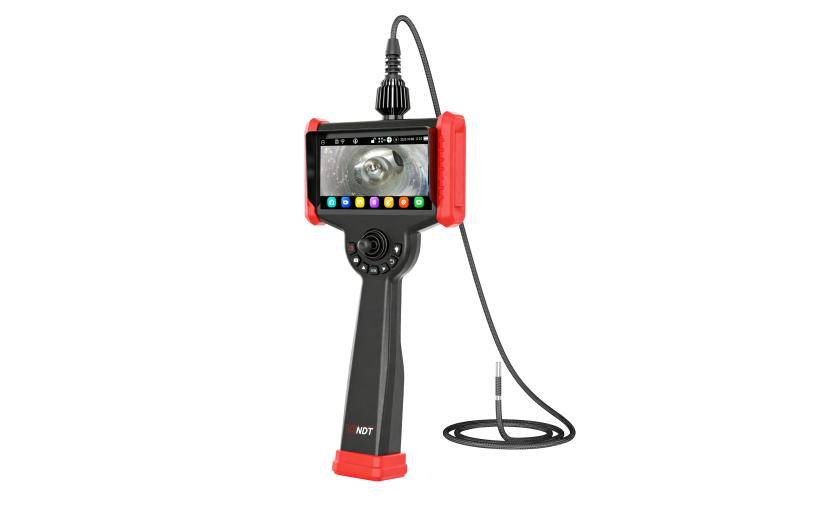
🛠️ P-Series Hardware Specifications: Precision-Matched for Aerospace Non-Standard Inspection
Aerospace inspection spans extreme aperture sizes, from hairline micro-holes to centimeter-scale pipelines, which is the core application scenario for the P-SERIES' multi-size probe matrix. The probes cover eight specifications: 0.75mm, 1.2mm, 1.8mm, 2mm, 2.4mm, 2.8mm, 3.9mm, and 6mm, perfectly matching all aerospace inspection points.
- 75mm Ultra-Fine Probe: A domestic industry-leading ultra-thin probe, specifically designed for aero-engine turbine blade film cooling holes and combustion chamber cooling micro-holes (typically 0.8-1.5mm in diameter), an extreme size that even imported endoscopes struggle to access.
- 2mm-2.8mm Probes: Ideal for hydraulic conduits, fuel pipelines, and landing gear actuator slender bent pipes.
- 9mm-6mm Large-Diameter Probes: Suitable for wide-range inspection of wing fuel tanks, engine nacelles, and honeycomb sandwich structures.
- Pipeline lengths are also tailored to aerospace differentiated needs:
- 5-2m Short Pipelines: Used for factory quality inspection of workshop components, ideal for close-up re-inspection of blades and nozzles on workbenches.
- 3-10m Standard Pipelines: Meet in-situ borescope inspection requirements for civil aircraft, allowing internal engine inspections without moving the entire aircraft.
- Up to 30m Custom Pipelines: Adapt to long-distance fuel delivery pipelines of launch vehicles and deep-buried airborne ventilation pipelines.
- The P-Series aerospace-specific pipelines use modified polyimide sheaths, different from ordinary TPU materials, withstanding short-term high temperatures of 120℃ from engine residual heat, resisting corrosion from aviation hydraulic oil and jet fuel, meeting high-cleanliness aerospace requirements with no debris or adhesive detachment, and eliminating pipeline debris contamination of oil circuits.

✈️ Aerospace-Exclusive Core Functions, Adhering to Industry Stringent Inspection Standards
- Unlike general industrial inspection, aerospace inspection has rigid compliance requirements for image quality, articulation, and data traceability.
Imaging Performance
- The P-SERIESis equipped with a 2MP high-definition aviation-grade CMOS sensor and built-in strong light adaptive suppression algorithm, automatically adjusting exposure for reflective engine turbine blades and dark combustion chamber environments with carbon deposits, avoiding local overexposure that masks micro-cracks. It comes standard with a high-color-rendering cold light source, free of photothermal radiation, which won't damage thin-walled titanium alloy blades in high-temperature residual states.
Maneuverability
- All probes support 360° omnidirectional electric articulation, and even the ultra-fine 0.75mm probe can achieve ±130° pitch and yaw, navigating through multi-stage curved paths after entering engine borescope ports without articulation jamming or angle drift.
Compliance & Traceability
- The device meets civil aviation authority ledger requirements with built-in time stamping, defect annotation, and dimension comparison measurement functions, directly generating NAS410-compliant inspection reports. Images and videos are encrypted and stored locally to prevent tampering with inspection data. Probes achieve IP68 dustproof and waterproof ratings, withstanding immersion in aircraft deicing fluids and cleaning solvents, while supporting sterile and dust-free wiping to meet high-cleanliness workshop inspection requirements for aerospace components. Pipelines support quick plug-and-play, allowing one host to switch between multiple probes, adapting to multi-category aerospace part inspection in the same workshop and reducing equipment procurement costs.

🌌 Full-Scenario Applications, Covering Both Civil Aviation and Aerospace Segments
(1) Civil Aviation Aircraft In-Service Maintenance and Overhaul
- Aero-Engine In-Situ Borescope Inspection: As one of the five core civil aviation maintenance tools, 1.2mm and 1.8mm probes are inserted through engine reserved borescope ports to detect high-pressure/low-pressure turbine blade ablation, tip curling, surface micro-cracks, and coating peeling, as well as internal bolt loosening and metal debris FOD. No disassembly of the entire engine is required, reducing single inspection time by 70%.
- Airborne Pipeline and Landing Gear Inspection: 2.4-2.8mm probes detect internal corrosion, weld micro-pores, and fatigue scratches in aircraft hydraulic oil circuits and fuel pipelines, preventing pipeline bursts during flight. 3.9mm probes inspect seal ring wear and cylinder inner wall corrosion in landing gear actuators, avoiding takeoff and landing safety hazards.
- Fuselage Composite Structure Inspection: 6mm probes detect water accumulation in wing honeycomb sandwich structures, corrosion in skin stringer connection gaps, and cracks around fastener holes, identifying hidden debonding defects in the fuselage to avoid in-flight skin delamination.
(2) Aerospace Component Manufacturing and Rocket Equipment Inspection
- Precision Power Component Quality Inspection: 0.75mm ultra-fine probes detect cooling micro-holes in rocket engine nozzles, internal sand holes in turbine blades, and casting inclusions, addressing the limitations of traditional X-ray inspection that cannot identify internal wall micro-scratches and filling gaps in NDT methods.
- Long-Distance Fuel Pipeline Inspection: Custom 20-30m pipelines inspect internal corrosion, excess weld beads, and residual metal shavings in long-distance curved fuel delivery pipelines of launch vehicles, eliminating fuel delivery blockage risks.
- Spacecraft Cabin Hidden Structure Inspection: Short 0.5m pipelines inspect wiring gaps and instrument installation clearances inside satellite cabins, verifying assembly misalignment and excess debris to ensure long-term stable on-orbit operation of spacecraft.
- ⚠️ Key Considerations for Aerospace Operations
- Aerospace scenarios cause far more wear and tear on endoscopes than general industrial scenarios, requiring adherence to specialized operating protocols:
- Wait 30 minutes after engine shutdown for residual heat dissipation, ensuring cavity temperature drops below 100℃ before inspection.
- Never use hard rags to wipe probe lenses to avoid scratching the coating and compromising imaging accuracy.
- After each aerospace inspection, perform dust-free degreasing cleaning on pipelines to remove jet fuel and hydraulic oil residues, preventing sheath aging and powdering that could generate debris.
- Compared to imported borescopes , the VSNDT P-SERIESoffers shorter delivery cycles, 55% lower probe repair costs, and supports non-standard customization of probe angles and pipeline lengths, adapting to domestic aerospace non-standard component inspection needs.